
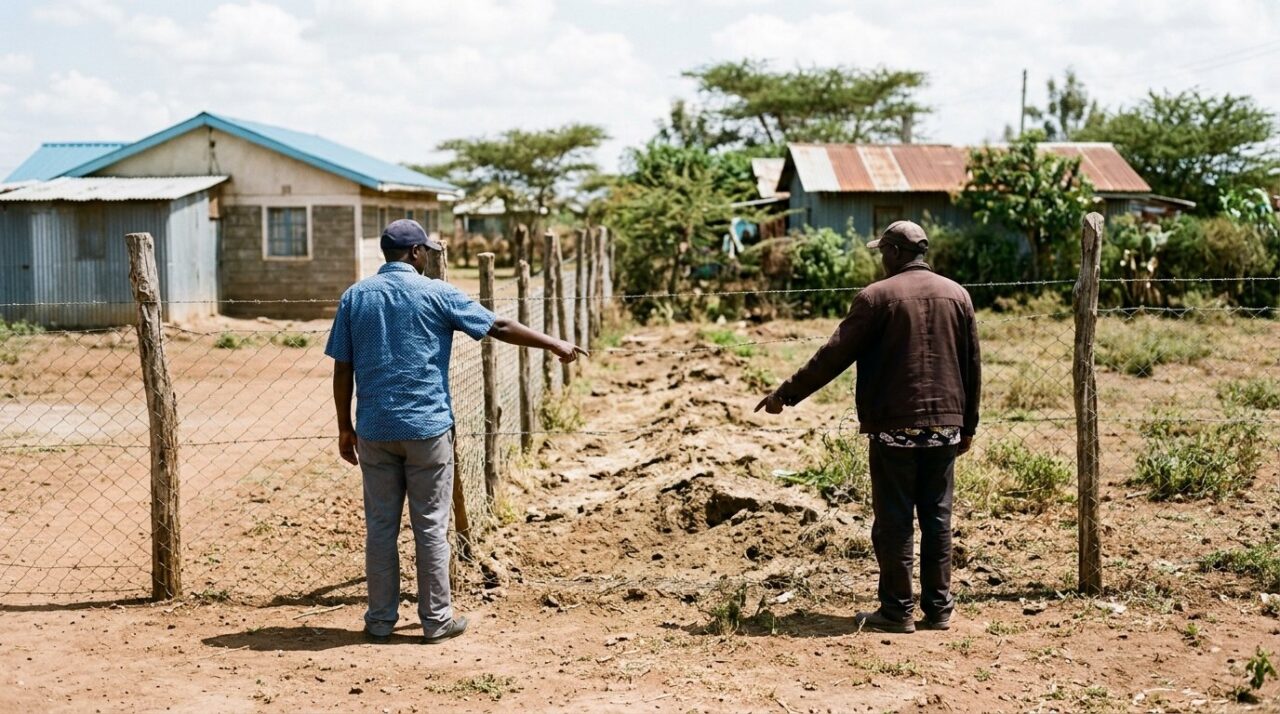
If you and your neighbour disagree about the boundary of registered land, you cannot take that boundary dispute straight to court. Under section 18(2) of the Land Registration Act (Cap. 300), the court will not hear it unless the boundaries have first been determined in accordance with section 18.
The Land Registrar comes first
The boundary must first be determined through the Land Registrar’s process. This is not a step to leave until after filing a court case. Filing first and dealing with the boundary question later does not satisfy the rule.
For example, you may believe your neighbour’s fence extends into your land, while your neighbour insists it follows the correct line. If the disagreement is about where the boundary of registered land lies, the starting point is the boundary determination process, not a court case asking the court to establish that line first.
Once the boundary has been determined through that process, the dispute may come before the court if a party remains dissatisfied. That does not promise a particular result: it means the required boundary step has come first.
A map may show only an approximate boundary
Section 18(1) makes an important distinction. Unless the register notes the boundaries as fixed, the cadastral map and filed plans show only approximate boundaries. A cadastral map is a map showing land parcels.
So, a line on a map should not automatically be treated as settling the exact position of a disputed boundary on the ground. Equally, moving a fence or putting down a marker yourself does not replace the Registrar’s process.
Section 18(3) allows the Registrar to receive evidence on boundaries and situation where they are not noted as fixed.
What should you do practically?
Keep copies of the land records you have, photographs of the disputed area and any correspondence with your neighbour. These can help you explain clearly what the disagreement concerns.
Ask the Land Registrar about having the boundary determined under section 18. If you are considering court proceedings, speak to an advocate about whether that determination has already taken place. The order matters: boundary determination first, court proceedings afterwards.
📚 Section 18(2), Land Registration Act (CAP. 300)
Entertainment and general information, not legal advice. For advice on your own situation, speak to an advocate.